
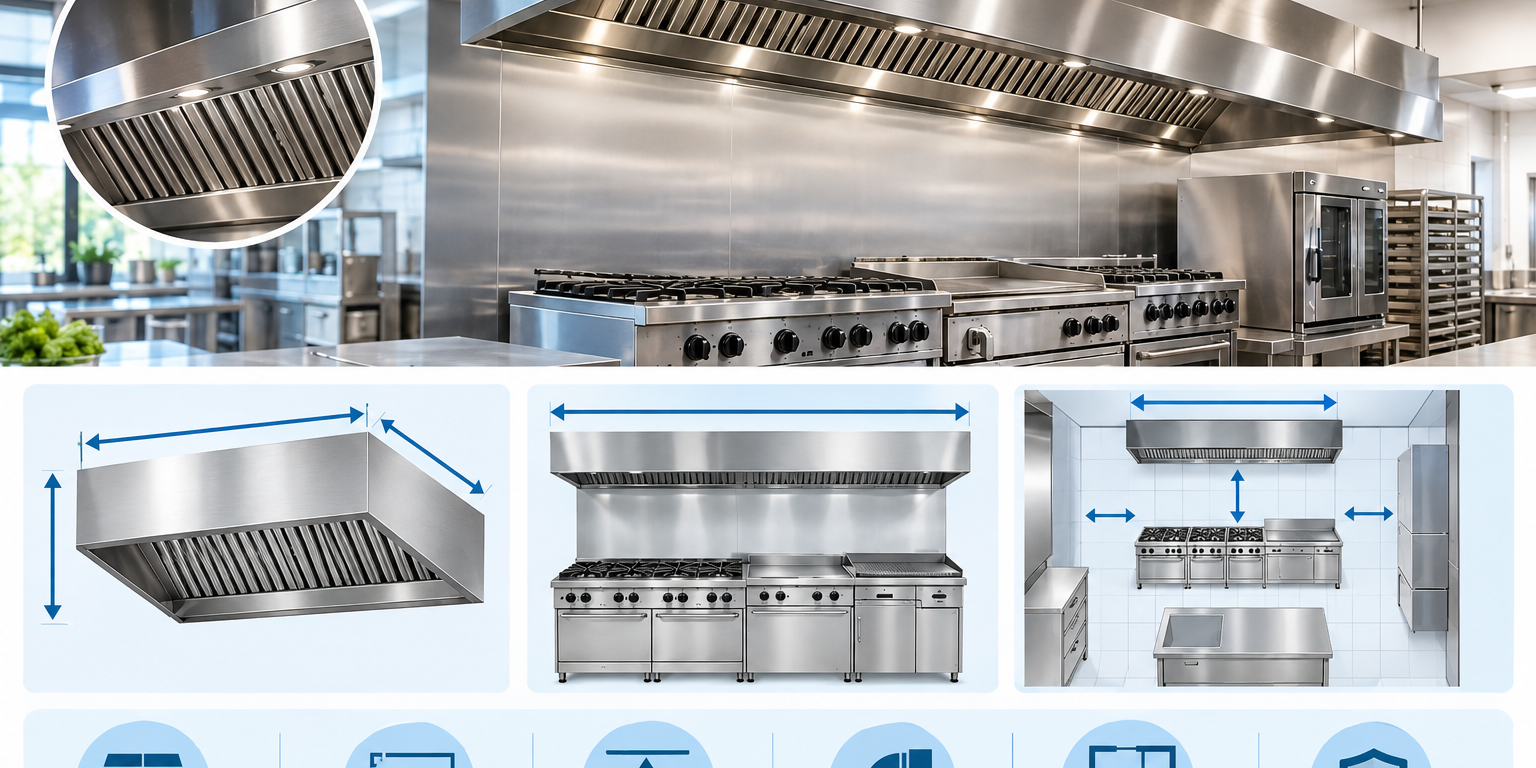
Choosing the right commercial exhaust canopy size is an important part of planning a restaurant, café, takeaway shop, hotel, catering kitchen or other commercial food premises.
A canopy that is too small may not adequately capture smoke, heat, steam and grease from the cooking equipment. A canopy that is unnecessarily large can increase fabrication, airflow, ducting and installation requirements.
There is no single commercial rangehood size that suits every kitchen. The appropriate dimensions depend on your cooking equipment, cooking intensity, kitchen layout, canopy position, ventilation design and other project requirements.
CGC Stainless Steel manufactures custom commercial exhaust canopies and rangehoods to suit different commercial kitchen layouts and cooking equipment.
What Is a Commercial Exhaust Canopy?
A commercial exhaust canopy is a ventilation hood positioned above cooking or heat-producing equipment. It forms part of a larger kitchen extraction system that may include grease filters, exhaust ducting, exhaust fans and make-up air.
The canopy is designed to capture contaminants generated during cooking, including:
- Smoke
- Heat
- Steam
- Grease-laden vapours
- Cooking fumes
- Odours and airborne contaminants
The canopy dimensions need to provide appropriate coverage of the cooking equipment while working with the overall ventilation system.
What Size Commercial Exhaust Canopy Do I Need?
The correct commercial exhaust canopy size depends primarily on the cooking equipment and the required capture area, rather than simply the overall size of the kitchen.
Before determining the dimensions, consider:
- The width of the cooking equipment
- The depth of the cooking equipment
- The type of appliances being used
- The cooking temperature and intensity
- Grease and heat production
- Whether the canopy is wall-mounted or island-style
- Available ceiling space
- Ducting requirements
- Exhaust airflow
- The location of the exhaust discharge
- Access for installation and maintenance
For example, a small café with a limited cooking line may require a very different canopy from a restaurant operating deep fryers, chargrills, woks and multiple commercial cooking appliances.
Commercial Exhaust Canopy Dimensions Explained
When discussing a commercial rangehood or exhaust canopy, three basic dimensions are particularly important:
1. Canopy Width
The width generally relates to the cooking line that the canopy needs to cover.
A canopy serving several appliances will generally need greater width than one installed above a single appliance or small cooking station.
The cooking equipment should therefore be considered before deciding on the final canopy width.
2. Canopy Depth
Depth determines how far the canopy extends over the cooking equipment.
The canopy needs to provide appropriate capture coverage without interfering with kitchen workflow, equipment access or other building components.
The required depth depends on the appliance configuration and ventilation design.
3. Canopy Height
The vertical dimensions of the canopy and its installation position need to be considered alongside the cooking equipment, ceiling height, available duct route and ventilation requirements.
The final installation height should be determined as part of the overall kitchen ventilation design rather than based on a generic measurement.
Common Commercial Rangehood Sizes
Commercial rangehoods and exhaust canopies can be fabricated in many different dimensions.
For example, CGC Stainless Steel’s commercial rangehood service information includes configurations around:
- 1200mm – suitable for some smaller cooking stations
- 1800mm – suitable for a broader commercial cooking line
- 2400mm – suitable for larger cooking areas
- Custom sizes – fabricated according to the kitchen layout and equipment
These should be treated as examples rather than universal sizes. The correct dimensions for a particular kitchen should be established from the actual cooking equipment and ventilation requirements.
Does the Cooking Equipment Affect Canopy Size?
Yes. The cooking equipment is one of the most important factors when determining the appropriate commercial exhaust canopy.
Different appliances produce different amounts of heat, steam, smoke and grease.
Common commercial cooking equipment includes:
- Deep fryers
- Chargrills
- Woks
- Griddles
- Gas cooktops
- Commercial ovens
- Salamanders
- Combination ovens
- Hotplates
A kitchen using high-grease or high-heat appliances may require a different extraction arrangement from a café primarily preparing lighter food.
This is why a commercial canopy should be designed around the actual cooking line, not selected simply by kitchen floor area.
Should the Canopy Be Wider Than the Cooking Equipment?
The canopy should provide appropriate coverage of the cooking equipment and be designed according to the ventilation requirements of the installation.
Simply choosing a canopy that is exactly the same width as the cooking equipment may not always provide the required capture area.
The final dimensions can depend on:
- Appliance arrangement
- Canopy position
- Cooking intensity
- Kitchen layout
- Required airflow
- Surrounding structures
- Applicable ventilation requirements
A professional assessment can help determine the appropriate dimensions before fabrication begins.
Wall-Mounted vs Island Exhaust Canopy Size
The position of the cooking equipment can also affect canopy design.
Wall-Mounted Commercial Exhaust Canopy
A wall-mounted canopy is positioned against or near a wall and is commonly used above cooking equipment arranged along a wall.
This configuration can be suitable for many restaurant, café and takeaway kitchen layouts.
The canopy dimensions need to suit the cooking line, available wall space and ventilation system.
Island Commercial Exhaust Canopy
An island canopy is installed above cooking equipment positioned away from a wall, often in the centre of a commercial kitchen.
Because the cooking area is exposed on multiple sides, the canopy design and capture requirements can differ from a wall-mounted installation.
Island canopies may also require careful planning for duct routing, ceiling structure and exhaust discharge.
How Does Canopy Size Affect Airflow?
Canopy dimensions and airflow are closely connected, but bigger does not automatically mean better extraction.
The ventilation system needs to be designed as a complete system.
Important factors include:
- Canopy dimensions
- Cooking equipment
- Heat output
- Grease production
- Required capture performance
- Exhaust airflow
- Duct dimensions
- Duct length
- Number of bends
- Exhaust fan capacity
- Make-up air
A canopy that is correctly sized but connected to an unsuitable duct or exhaust fan may not perform as expected.
Likewise, increasing the canopy size without considering the complete ventilation system can affect the overall design.
Why Ducting Matters When Choosing a Commercial Canopy
The exhaust canopy is only one part of a commercial kitchen extraction system.
Extracted air needs to travel through ductwork before being discharged from the building.
The duct design can be affected by:
- Canopy location
- Ceiling height
- Duct length
- Number of bends
- Building layout
- Roof access
- Exhaust discharge location
- Available installation space
- Fan selection
A long or complicated duct route may create additional resistance and influence the ventilation system design.
For this reason, ducting should be considered before the final canopy dimensions are confirmed.
Does Kitchen Size Determine Commercial Rangehood Size?
Not by itself.
A large kitchen does not necessarily require one large exhaust canopy, while a smaller kitchen can still require substantial extraction if it contains high-output cooking equipment.
The more useful starting point is the cooking line and ventilation requirements.
For example:
Small café:
A compact cooking area may use a smaller custom canopy.
Restaurant:
A longer cooking line with fryers, grills and cooktops may require a larger canopy.
Hotel or catering kitchen:
A large-volume cooking operation may require multiple canopy sections or a larger custom-designed system.
The kitchen floor area is therefore only one part of the overall design.
Commercial Exhaust Canopy Size and Australian Standards
Commercial kitchen ventilation needs to be designed with applicable Australian requirements in mind.
CGC Stainless Steel’s commercial rangehood systems are designed with consideration of applicable ventilation and compliance requirements, including AS 1668.
However, the exact requirements can vary according to the building, cooking equipment, ventilation arrangement and project.
For this reason, businesses should avoid choosing canopy dimensions solely from an online size chart.
The final design should be assessed against the requirements applicable to the specific commercial kitchen.
What Information Do You Need Before Ordering a Commercial Exhaust Canopy?
Having the right information available can make the design and quotation process much easier.
Before contacting a commercial exhaust canopy manufacturer, prepare:
Kitchen measurements
Provide the available kitchen dimensions, ceiling height and proposed canopy location.
Cooking equipment list
Include the type and dimensions of every appliance that will sit beneath the canopy.
Kitchen floor plan
A floor plan can help show the relationship between the cooking line, walls, doors, preparation areas and other equipment.
Duct route
If known, identify where the exhaust duct will travel and where the extracted air will be discharged.
Building information
Information about roof access, ceiling structure and existing ventilation can help identify installation considerations.
Business operation
Explain whether the kitchen is a café, restaurant, takeaway shop, hotel, catering facility, food production area or another type of commercial operation.
This information helps the manufacturer understand the project rather than relying on a generic canopy size.
Commercial Exhaust Canopy Size Checklist
Before finalising your canopy, consider these questions:
- What cooking equipment will be installed?
- What are the width and depth of the cooking appliances?
- How much heat and grease will the cooking process generate?
- Is the canopy wall-mounted or island-style?
- What is the ceiling height?
- Where will the canopy be positioned?
- Where will the exhaust duct run?
- Where will the extracted air be discharged?
- What exhaust airflow is required?
- Is make-up air required?
- How will the canopy be accessed for cleaning?
- How will grease filters be removed and maintained?
- What compliance requirements apply to the premises?
- Does the proposed canopy work with the building structure?
Answering these questions early can help avoid costly changes later.
Why Custom Commercial Exhaust Canopies Can Be Useful
Commercial kitchens rarely have identical layouts.
One restaurant may have a short cooking line against a wall, while another may have a central island with multiple appliances.
Custom fabrication allows the canopy to be designed around:
- Cooking equipment
- Available space
- Kitchen layout
- Ceiling height
- Duct position
- Filter arrangement
- Ventilation requirements
- Installation conditions
CGC Stainless Steel manufactures custom stainless steel commercial exhaust canopies and rangehoods for different commercial kitchen applications.
Choosing the Right Stainless Steel for Your Canopy
The material used for a commercial exhaust canopy is another consideration during fabrication.
CGC Stainless Steel works with 304 and 430 stainless steel options, depending on the requirements of the project.
Stainless steel is widely used in commercial kitchens because it provides a durable, cleanable and professional surface suitable for demanding food-service environments.
The appropriate material and thickness should be selected according to the specific application and fabrication requirements.
What Happens If a Commercial Exhaust Canopy Is Too Small?
An undersized canopy may not provide sufficient coverage of the cooking equipment.
Potential problems can include:
- Smoke escaping into the kitchen
- Excess heat around cooking equipment
- Grease settling on nearby surfaces
- Steam accumulation
- Poor capture performance
- Reduced staff comfort
The exact performance depends on the complete ventilation system, so canopy size should always be considered together with airflow, ducting, filters and fan selection.
What Happens If a Commercial Exhaust Canopy Is Too Large?
Larger is not automatically better.
An unnecessarily large canopy can increase:
- Stainless steel requirements
- Fabrication requirements
- Filter requirements
- Airflow requirements
- Exhaust fan requirements
- Ducting requirements
- Installation complexity
The objective should be an appropriately designed canopy that provides suitable coverage and works efficiently with the complete extraction system.
How CGC Stainless Steel Can Help
CGC Stainless Steel provides custom commercial exhaust canopy and rangehood fabrication for commercial kitchens.
Our team can work from your kitchen layout, cooking equipment and project requirements to develop a suitable stainless steel canopy solution.
Services can include:
- Custom commercial rangehood fabrication
- Commercial exhaust canopy fabrication
- Stainless steel fabrication
- Exhaust ducting
- Grease filtration
- Exhaust fan integration
- Commercial kitchen ventilation solutions
- Installation
We work with restaurants, cafés, takeaway shops, hotels, catering facilities, food businesses and other commercial kitchen operators.
Commercial Exhaust Canopy Size FAQs
What is the standard size of a commercial exhaust canopy?
There is no single standard size for every commercial kitchen. Canopies can be manufactured in different dimensions, including configurations around 1200mm, 1800mm and 2400mm, as well as custom sizes. The appropriate size depends on the cooking equipment and ventilation requirements.
How do I calculate commercial exhaust canopy size?
Start with the dimensions and configuration of the cooking equipment, then consider the required capture area, canopy position, cooking intensity, airflow, ducting and applicable ventilation requirements. The final dimensions should be confirmed as part of the overall system design.
Should a commercial rangehood be wider than the cooking equipment?
The canopy needs to provide suitable coverage for the cooking equipment. The required coverage depends on the appliance configuration, canopy position and ventilation design, so a simple width rule should not be applied to every kitchen.
Does a larger commercial canopy provide better extraction?
Not necessarily. Canopy dimensions need to work with the exhaust airflow, filters, ductwork and fan. An oversized canopy may increase system requirements without necessarily improving performance.
What size rangehood do I need for a restaurant?
It depends on the restaurant’s cooking equipment, cooking intensity, kitchen layout, canopy configuration and ventilation system. A restaurant with fryers, grills and woks may require a different system from a small café.
What is the difference between a 1200mm and 1800mm commercial rangehood?
The main difference is the width and the amount of cooking equipment the canopy can potentially cover. The appropriate configuration should be determined from the actual cooking line and ventilation requirements.
Can a commercial exhaust canopy be custom-made?
Yes. Custom fabrication is useful where the kitchen has unusual dimensions, multiple appliances, restricted space or a specific ventilation layout.
Does the canopy size affect the exhaust fan?
Yes. Canopy dimensions form part of the overall ventilation design. Exhaust fan selection also depends on cooking equipment, required airflow, duct dimensions, duct length and system resistance.
Does ducting affect commercial exhaust canopy design?
Yes. The duct route, length, bends, roof access and discharge location can affect the overall ventilation system and should be considered when planning the canopy.
Do I need a commercial exhaust canopy for a café?
Many cafés using commercial cooking equipment require suitable mechanical ventilation. The exact system depends on the appliances, cooking operation, premises and applicable requirements.
Final Thoughts: Choose the Canopy Around the Kitchen
The right commercial exhaust canopy size is not simply a matter of choosing the largest available hood or matching the canopy width to the kitchen.
The better approach is to design the canopy around the cooking equipment, cooking intensity, capture requirements, kitchen layout, airflow, ducting and applicable Australian requirements.
A properly planned system can help manage smoke, heat, steam and grease while supporting a more comfortable and functional commercial kitchen.
If you are planning a new commercial kitchen, renovating an existing kitchen or replacing an exhaust canopy, CGC Stainless Steel can manufacture a custom stainless steel solution based on your project requirements.
Need a custom commercial exhaust canopy? Contact CGC Stainless Steel to discuss your kitchen layout, cooking equipment and ventilation requirements and request a quote.